Harp Solitaire Objective
The goal of Harp Solitaire is to complete eight foundation piles (two for each suit) that ascend in order from
ace to king.
Harp Solitaire Setup
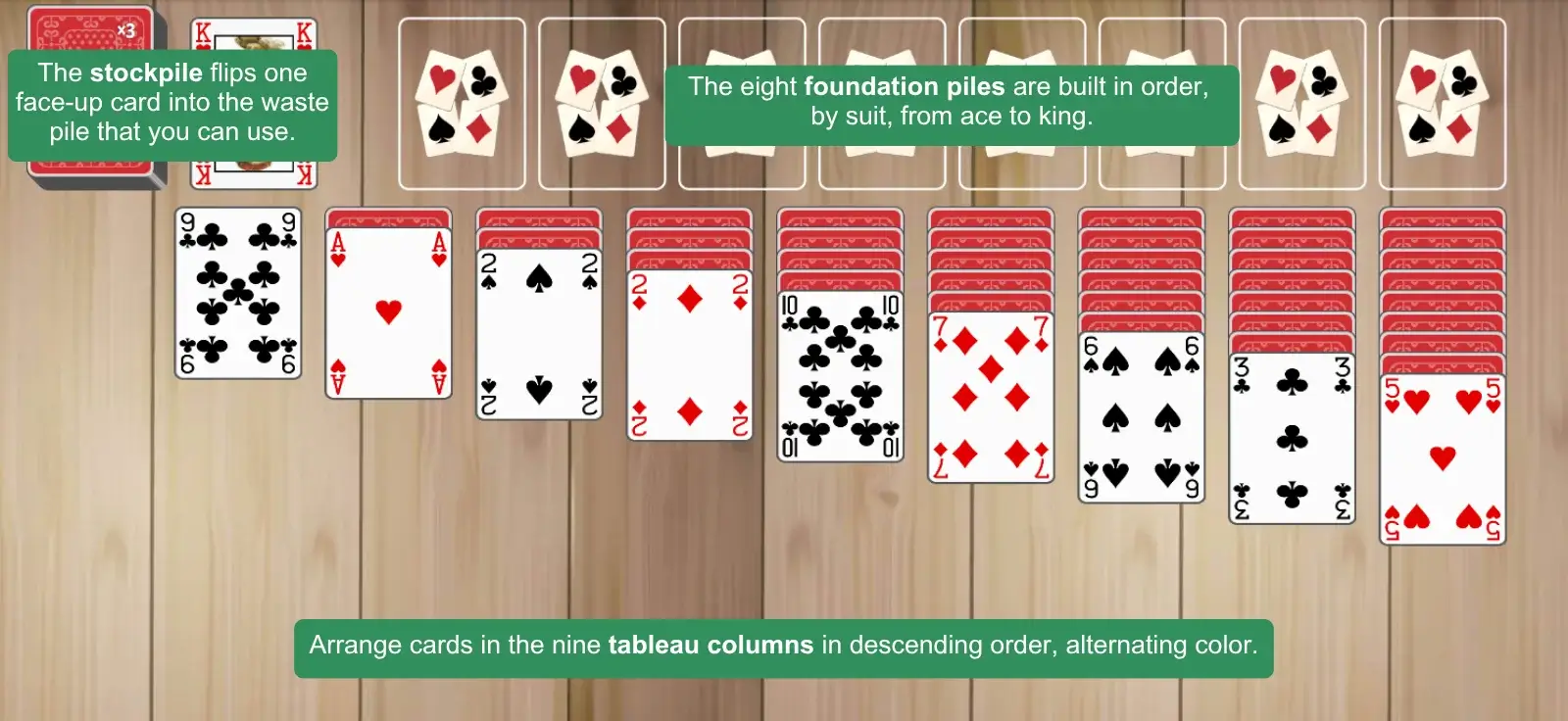
Harp Solitaire uses two 52-card decks and is laid out in four main areas:
-
Tableau: The tableau is where you arrange cards in descending order, alternating color. It consists
of 45 cards across nine columns, with each column containing one more than the last (the first has one, the
second has two, and so on). The last card in each column is face up.
-
Stockpile: The rest of the cards (59 cards) are placed facedown into a stockpile. You can flip one
card from the stockpile face up into the waste pile, which makes it available to play, but you only get
three passes through the stockpile.
-
Waste pile: Cards flipped over from the stockpile are face up in the waste pile, which means they can
be played in the tableau or onto foundation piles. If you play the top card of the waste pile, the next card
becomes available to play.
-
Foundation piles: Eight foundation piles are above the tableau. You must start each foundation pile
with an ace and build it in ascending order, ending with a king. You have two piles for each suit to
complete, and to win the game, you must finish them all.
Harp Solitaire Rules
-
Sequence cards in descending order and alternating by color. For example, you can place a 6♥ on a
7♠.
-
Play only face-up cards. You can play the top card of the waste pile or the last face-up card from
each column.
-
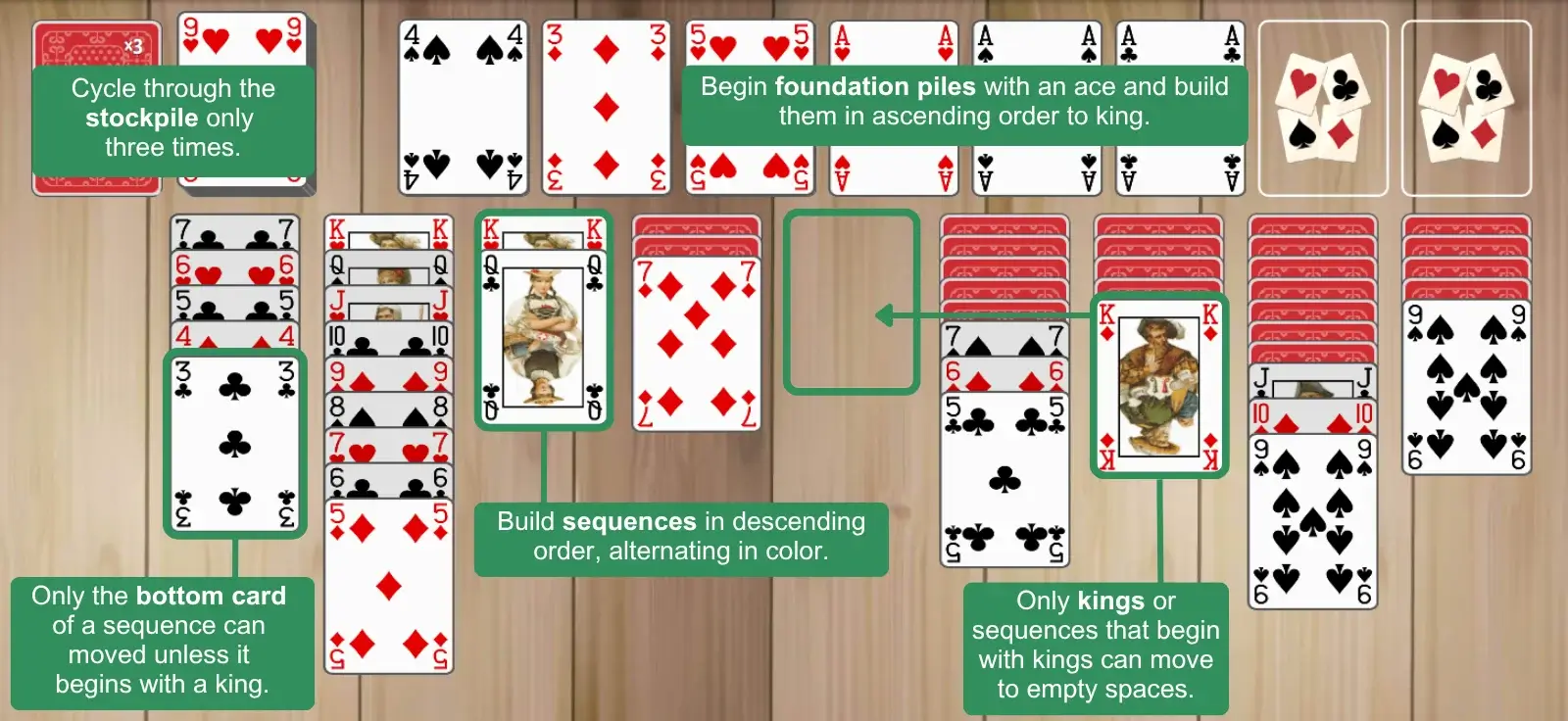
You can only move the bottom card from any sequence unless it begins with a king. For example, if one
column has a 7♥, 6♠, and 5♦, you can’t move that sequence onto an 8♣. You can only move the 5♦ onto
another black six. However, sequences beginning with a king can be moved.
-
Only kings or sequences that begin with kings can fill empty columns. The only sequence of cards that
can be moved to an empty column in the tableau is one that begins with a king.
-
Foundation piles ascend in order from ace to king and are separated by suit. Start foundation piles
with an ace and then build them in order until they are completed with a king. Each suit has two foundation
piles.
-
Use the stockpile when you run out of moves. The stockpile flips a single card face up into the waste
pile for you to play. You can use this card to play in the tableau or to play on foundation piles, but you
can only cycle through the stockpile three times. So if you haven’t completed all the foundation piles and
you’ve gone through the stockpile three times, the game is over.
Harp Solitaire Strategies
-
Focus on getting facedown cards into play. You can access every card in the stockpile, so you need to
reveal the hidden cards in the tableau as quickly as possible to give yourself more options for sequencing.
-
Prioritize sequencing with kings. Because sequences starting with kings are the only sequences that
can move to empty spaces, prioritize sequence building on kings.
-
Dedicate one or two columns to non-king sequences. Select two columns that don’t contain a king in
which you can build sequences that won’t move. Select columns that have a high-ranking card, such as an
eight or above so you can build a long sequence, and try to select columns that don’t have larger stacks of
hidden cards. Creating sequences that don’t start with kings blocks your access to facedown cards in those
columns. But allowing just a couple of columns to be sequenced gives you a way to balance getting more cards
into play while not blocking too many hidden cards.
-
Use the foundation piles as storage. Unless the sequence begins with a king, play available cards
onto their foundation piles. This allows you to move cards out of the tableau, undo sequences that don’t
start with kings, and get more stacks of hidden cards revealed. Then you can move cards from foundations
piles back into the tableau as needed.
-
Use the stockpile as a last resort. You have to use the stockpile in this game to get cards into
play, and sometimes you may feel like you’re flipping several cards into the waste pile before you find a
playable card. However, because you only get three cycles through the stockpile, be sure you’ve exhausted
good moves in the tableau and foundation piles before using the stockpile.
-
Be cautious when emptying columns. Emptying a column takes away a place you can sequence cards. So
you have to weigh your options before removing the last card in a column. You should always move the last
card if you’re moving it to a sequence that starts with a king. But you should avoid moving the last card in
a column if it can only be played on its foundation pile unless you know you have a king nearby in the
tableau or stockpile to move into the empty space. Otherwise, keeping the card there gives you another spot
to build a sequence on and get more cards into play.
If you find Harp Solitaire to be a lot of fun, challenge yourself further with
Canfield Solitaire, but if you need a little practice with
the basics and want something easier, try playing
Easy Harp, which allows unlimited use of the
stockpile, or Solitaire Turn 3. Play them all for free
on Solitaire Bliss!