Forty and Eight Objective
The goal of Forty and Eight is to move all 104 cards to the eight foundation piles (two for each suit), building
each foundation from ace to king by suit.
Forty and Eight Setup
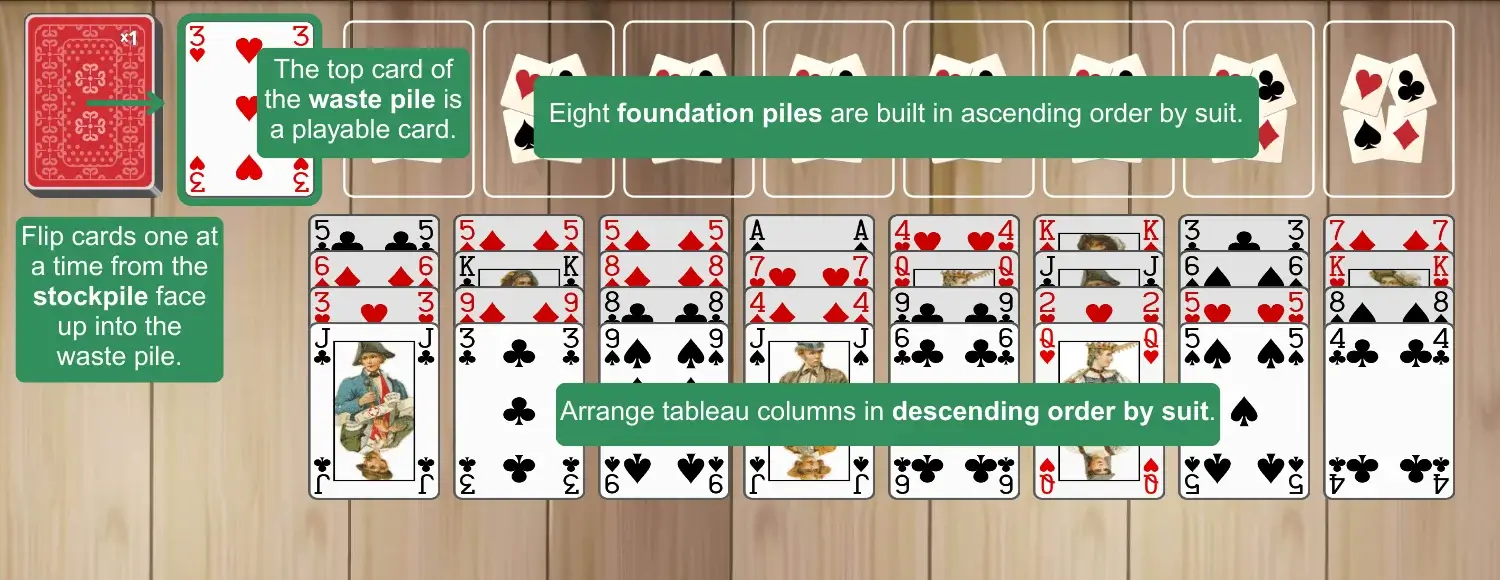
Forty and Eight uses two standard 52-card decks (104 cards) and is set up as follows:
-
Tableau: The main playing area, the tableau consists of eight columns with five face-up cards in
each. You build tableau columns in descending order by suit, but only the top card of each pile is available
for play, even if it’s part of a sequence.
-
Foundations: Above the tableau, you have eight foundation piles, two for each suit. You must start
foundations with an ace and build them in ascending order by suit. You can move cards from the waste pile or
the tableau onto a foundation pile.
-
Stockpile: The remaining cards are placed facedown into the stockpile. You turn cards face up from
the stock one at a time and place them into the waste pile. You can cycle through the stockpile just two
times.
-
Waste pile: Flip cards from the stockpile into the waste pile. Only the top card can be played to the
tableau or foundations. Once you play it, the next card is then available to play.
Forty and Eight Rules
-
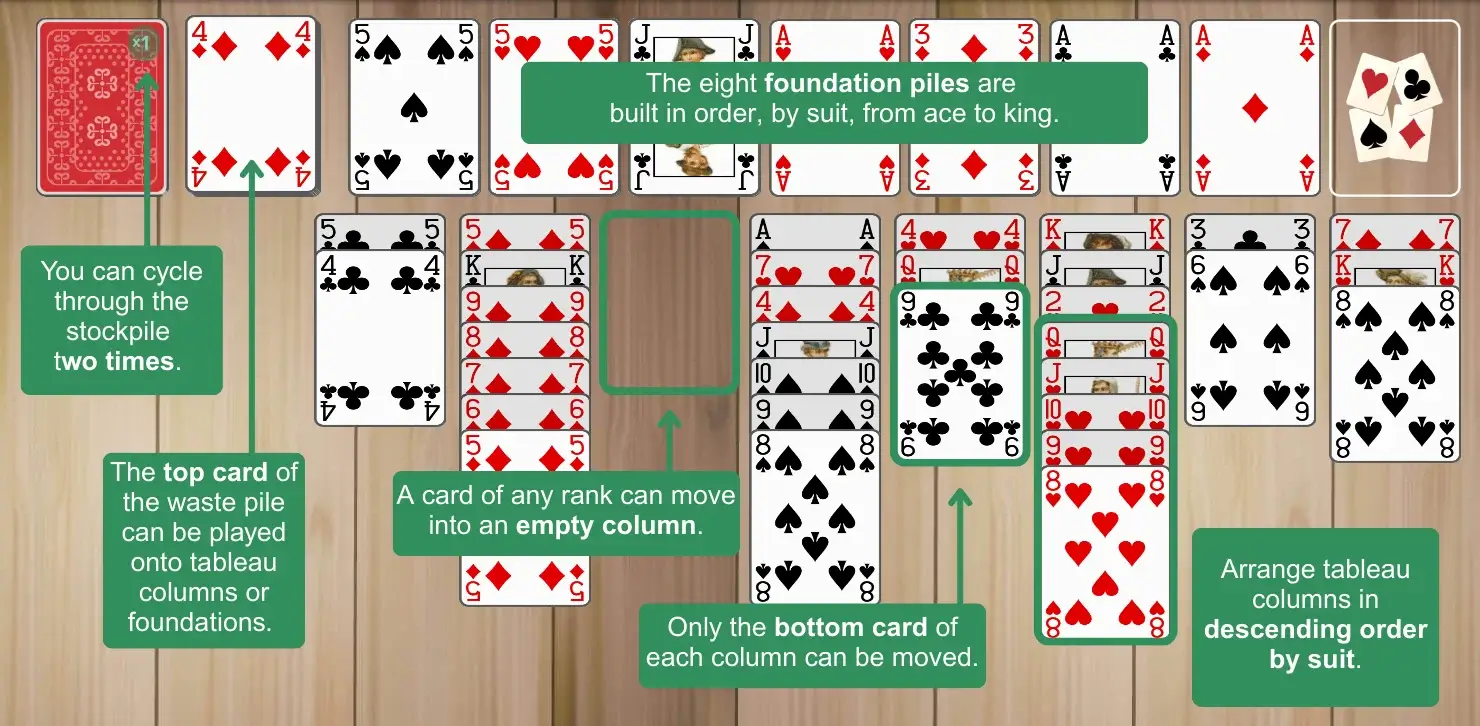
Build foundations by suit in ascending order from ace to king. Each foundation pile must begin with
an ace and then be built in ascending order until it’s completed with a king.
-
Build tableau piles in descending order by suit. You can move a card onto another card as long as
it’s part of the same suit and is placed on a card that is one rank higher. So a 4♣ can be moved on top of
a 5♣.
-
Only the bottom card in each column can be moved. You can only move single cards, not sequences in
this game. So even if the bottom card in a column is part of a sequence, you can only move that bottom,
exposed card to another tableau column or onto a foundation pile.
-
Any card can fill an empty space. When you clear a tableau pile, you may move any single card into
that empty space, regardless of rank. Using empty spaces wisely is key to creating new sequences and freeing
buried cards.
-
Turn one card at a time from the stock to the waste. When no more useful moves are available from the
tableau, turn the top card of the stockpile face up onto the waste pile to expose a new, playable card. You
can cycle through the stockpile only twice.
-
Only the top card of the waste pile can be played. The face-up card on top of the waste pile can
either be moved onto a tableau column to build a sequence or can be placed onto a foundation pile. After
that card is played, a new card is revealed and becomes playable. You can play as many cards out of the
waste pile as possible.
-
You win if you complete all eight foundation piles. After you’ve built all eight foundation piles in
ascending order from ace to king, you win!
Forty and Eight Strategies
-
Empty one to two columns and keep them free. By far the most play-opening strategy is keeping columns
empty. Because you can only move one card at a time, long sequences may block cards. Free columns let you
deconstruct sequences and rebuild them, freeing the cards you need.
-
Focus on uncovering aces and twos in the tableau. Starting your foundation piles gives you more
places to place cards and keeps the game moving toward a win.
-
Track lower cards in the first round of the stockpile. You get two cycles through the stockpile, and
you’ll likely pass up some lower cards that are vital to building your foundation piles. So track cards of
lower rank (under five), so you know whether they are at the beginning or end of the stockpile. Knowing
where cards might be that are blocking plays can help inform your moves in the tableau.
-
Avoid overloading multiple columns with sequences. Just like you want to keep some columns empty for
rearranging, try not to build lengthy sequences in too many columns so you can access covered cards.
-
Move cards to the foundations whenever you can. You have to build tableau columns as well as
foundation piles by suit, so it does you no good to leave cards sitting in the tableau like you would in
games where sequences must alternate colors. Keep the cards moving by placing them into foundation piles
when you can.
If you’re getting the hang of Forty and Eight, challenge yourself to more advanced variations of the game, such
as Forty Thieves or
Josephine, and play them all for free on
Solitaire Bliss!