Baker’s Game Objective
The goal of Baker’s Game is to complete four foundation piles, separated by suit, that ascend in order from ace
to king.
Baker’s Game Setup
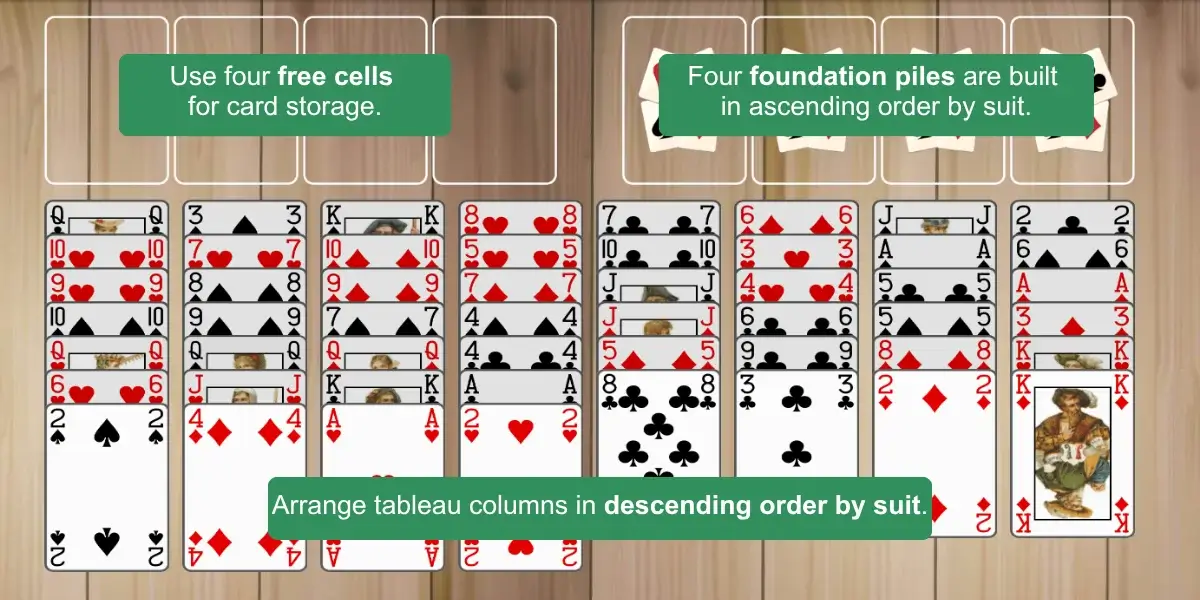
Baker’s Game uses one 52-card deck and is laid out in three main areas:
-
Tableau: The tableau consists of all 52 cards dealt face up into eight columns, which you sequence in
descending order by suit. The first four columns have seven cards, and the last four columns have six cards.
-
Free cells: Four free cells are located above the top-left area of the tableau. You can use the free
cells as a temporary placeholder for cards.
-
Foundation piles: Four foundation piles are located above the top-right area of the tableau. Each
foundation pile must begin with an ace and build in ascending order until it ends with a king. Completing
all four foundation piles means you win the game.
Baker’s Game Rules
-
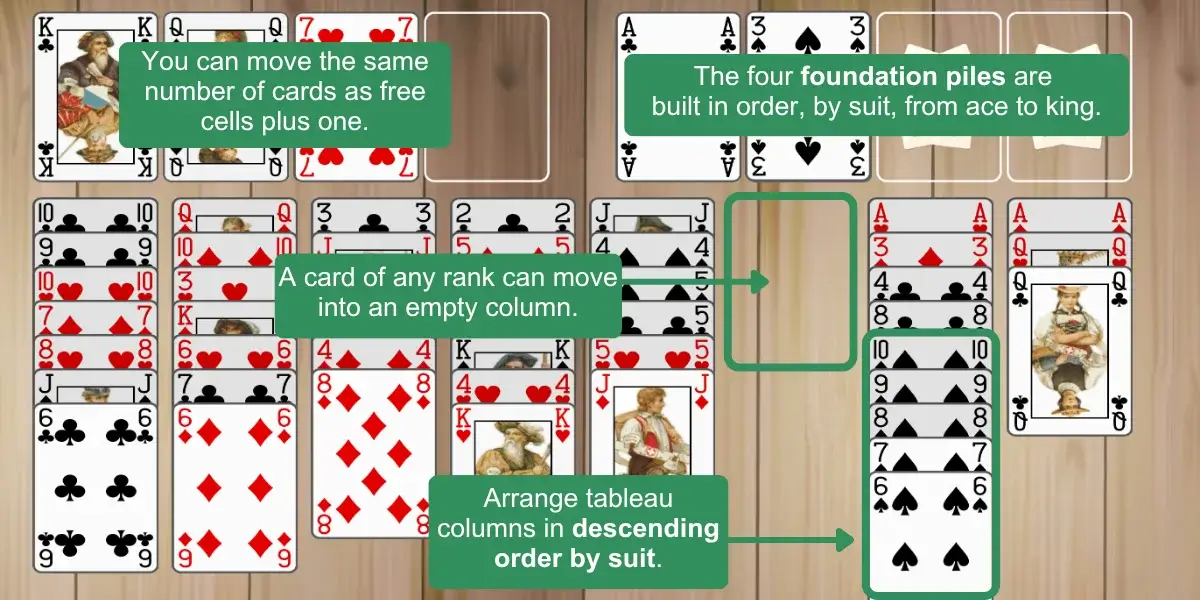
Sequence cards in descending order by suit. Cards in the tableau must be sequenced in descending
order. For example, you can place a 7♦ on an 8♦.
-
You can move one more card than the number of open free cells. If all four free cells are open, you
can move a sequence of five same-suit cards. If you only have two cells open, you can only move three cards.
-
Any card or sequence can move into an empty column. Unlike Klondike Solitaire, you can move any card
into an empty column regardless of rank. Sequences of cards can be moved into empty columns as well,
provided you have the free cells open.
-
Start foundation piles with aces. Foundation piles must begin with an ace and ascend in order to
king.
Baker’s Game Strategies
-
Survey the tableau to plan your moves. Because each card has just one card it can be sequenced with,
you have to anticipate where the biggest blocks to movement are located. Buried aces will keep you from
moving cards into foundation piles, and buried high-ranking cards like kings can impact your ability to
build long sequences.
-
Prioritize emptying columns. You give yourself a free space for sequence building when you empty a
column. Be sure to use a high-ranking card in the empty column so you can build a long sequence.
-
Build long sequences in empty columns. If you build long sequences in every column, you could block
the unsequenced cards, but if you focus on building long sequences in empty columns, you have more
flexibility.
-
Move cards to foundations liberally. Because you have to build tableau columns by suit, you can
freely move cards to their foundation piles without blocking future tableau moves.
-
Make free cell storage temporary. Have a plan for moving cards back out of the free cells. For
example, don’t put the 6♣ and 7♣ in the last two free cells available unless you’re moving them to reveal
and place them in sequence on the 8♣. Moving too many cards into free cells with no plans of getting them
back into play will get you stuck quickly.
If you enjoy Baker’s Game, try other difficult Solitaire variations, such as
Yukon and
Spider Solitaire 2 Suits, for new challenges. Play
them all for free on Solitaire Bliss!