
Rushed vs. Thorough: An Analysis of Doctor Visits Across the U.S.

Whether you’re simply going in for a check-up or you’re struggling with a cold, no one wants to spend their day in the waiting room of a doctor’s office. Even when longer waits are the result of thorough, attentive care—or unexpected needs earlier in the day—it can still be frustrating to watch the minutes tick by, no matter how great the magazines are or how long of a winning streak you’ve built with your Solitaire game.
At Solitaire Bliss, we know that long waits don’t always equate to a negative experience at the doctor’s office. Often these waits are simply due to patients needing different levels of time and attention, but waiting room experiences can vary widely. That’s why we set out to learn more about the state of doctor visits in the U.S.
To do this, we collected 1.36 million reviews from more than 6,000 doctors offices across the U.S. We then analyzed reviews for mentions of 80 keywords related to long waits, thorough visits, and more to determine the cities where doctors make patients wait the longest and where the wait is worth it. Read on to learn more about our findings.
Key Takeaways
- Riverside, CA, Seattle, WA, and Fresno, CA, doctors' offices have the longest waits.
- Riverside, CA, Cleveland, OH, and Fresno, CA, residents are the most likely to feel rushed during doctor visits.
- San Francisco, CA, New Orleans, LA, and San Jose, CA, are home to the most thorough doctors.
- San Francisco, CA, San Jose, CA, and Sacramento, CA, are home to the most attentive doctors.
- New York, NY, Tampa, FL, and Washington, D.C., are the top cities where doctors are considered worth the wait.
Cities Where Doctors Make Us Wait the Longest
To gain insight into Americans’ experiences with doctors’ offices, we first focused on complaints of long waits. Many of us have been there. You schedule an appointment, get to the office early to ensure all paperwork is in order, and sit waiting in the lobby past your scheduled start time. While several issues can cause long waits, from short-staffed facilities to doctors providing attentive care, spending a long time in a waiting room can be frustrating.
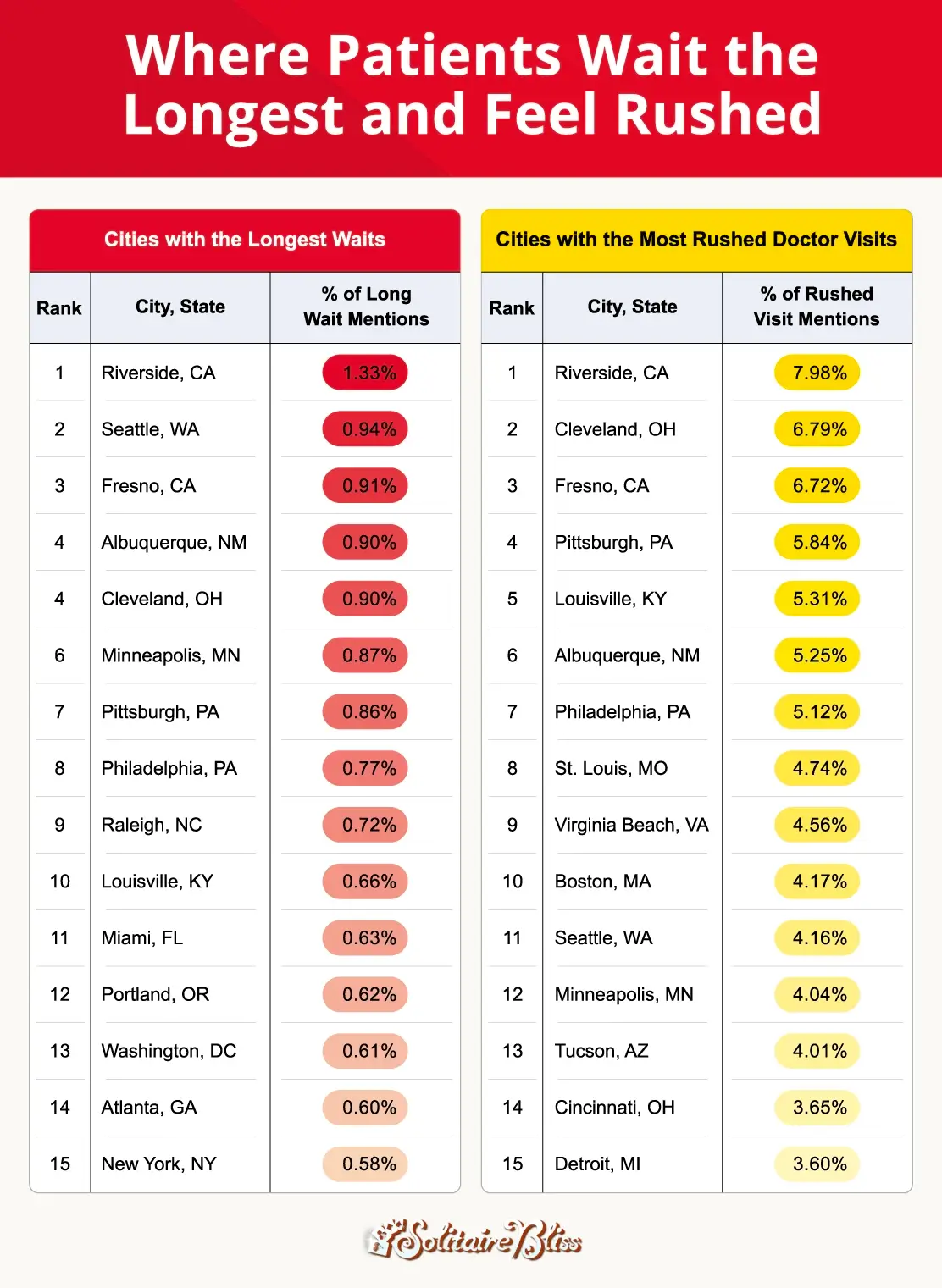
Overall, we found Riverside, CA, is home to the longest waits at doctors’ offices with 1.33% of reviews complaining about wait times. Remaining on the west coast, Seattle, WA, takes second place as 0.94% of reviews contain complaints about long waits. Wrapping up our top three, we travel back to California as Fresno, CA, claims third place for doctors’ offices with the longest waits.
Up next we have a tie for fourth place as both Albuquerque, NM, and Cleveland, OH, rank with 0.90% of reviews complaining about lengthy wait times. This is followed by Minneapolis, MN, (0.87%), Pittsburgh, PA, (0.86%), and Philadelphia, PA, (0.77%) claiming sixth, seventh, and eighth place, respectively.
In addition to lengthy waits at doctors’ offices, we also analyzed reviews for mentions of rushed appointments. For this, we included a variety of keywords such as “rushed appointment,” “doctor was in a hurry,” “spent no time,” and more. Leading the way for rushed visits is Riverside, CA, with 7.98% of reviews mentioning a lack of time with the doctor.
Cleveland, OH, is up next as 6.79% of doctors’ office reviews contain complaints of rushed visits. This is followed by another city that landed high on the long-wait ranking, Fresno, CA, with 6.72% of reviews mentioning a rushed visit.
If you are among those who feel rushed or unheard during your doctors’ appointments, experts suggest picking quieter appointment times, planning priority topics to focus on, and simply talking to your doctor about your feelings regarding the time you spend together.
Where the Wait Is Worth It
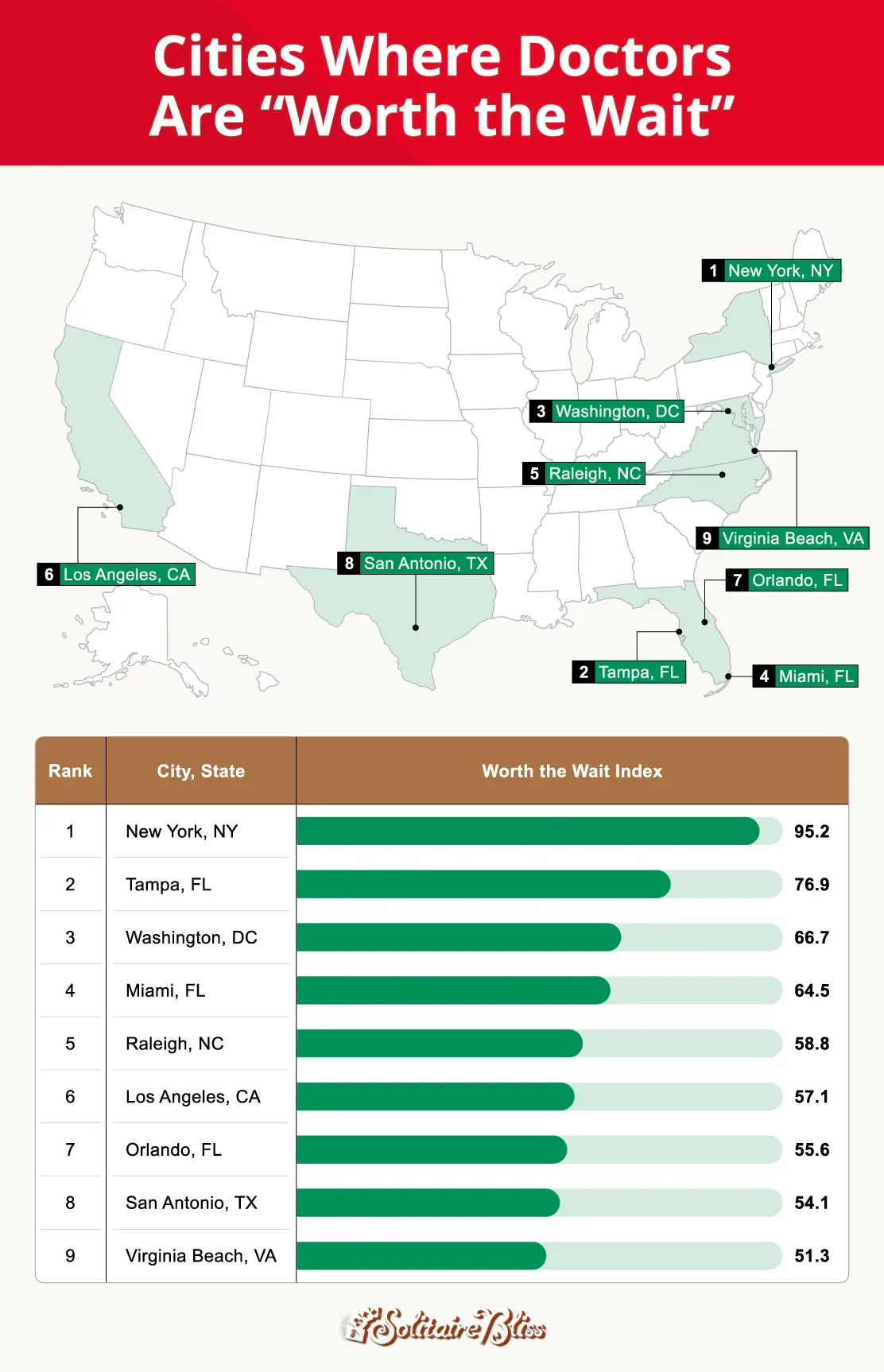
While long waits can make us feel antsy, when paired with a caring, thorough doctor, it can be easy to overlook the time spent in a waiting room as we begin to understand the reason for the delay. To show this side of doctors’ appointments, we calculated the cities that scored higher than the median for both long waits and attentive doctors to create a Worth the Wait Index.
Leading this “worth the wait” ranking is New York, NY, with a score of 95.2. While the Big Apple ranks 15th for complaints of long waits, 13.77% of doctors’ office reviews mention thorough visits. Additionally, 7.92% of reviews praise doctors for being attentive.
Up next is Tampa, FL, with a worth the wait score of 76.9. Although Tampa ranks 16th for long waits, 12.28% of patient reviews note how caring their doctor was. Washington, D.C., follows closely behind in third place (66.7) as the capitol city ranks 10th for the offices with the best listeners.
Kill Time in the Waiting Room with Solitaire Bliss
Although one situation can vary to the next, we at Solitaire Bliss encourage you to remember that sometimes medical emergencies arise, and at other times, a routine exam runs longer than expected when something more serious is discovered.
While it can be frustrating to wait around for your name to be called, it is important to remain respectful of both doctors and other members of the office staff as they work to ensure every patient is cared for.
We think that Adam B. Rosenbluth, M.D., an internist and cardiologist in New York City, says it best, “I apologize that you had to wait. But please understand, it’s because someone who is ill needed more time than anticipated. I’m sure you would want me to give you [the] same care and consideration.”
So next time, you find yourself growing tired of the time spent in a waiting room, try an online game to keep your mind occupied. From games like Spider Solitaire and FreeCell to Pyramid Solitaire and Tri Peaks Solitaire, you are sure to find a game that will help time pass by quicker until it’s your turn to see the doctor.
Methodology
In January 2026 we analyzed 1.36 million Google reviews of 6,139 doctors' offices in major cities throughout the U.S.
Our analysis focused on generalist doctors who identified as family practice physicians, pediatricians, and internists. We were interested in measuring regional trends in the experience patients have with doctors, ranging from satisfying to frustrating. Specifically, we searched for 80 different keywords within the reviews, indicating different sorts of experiences. We grouped the keywords into categories that characterize the patient experience. On the frustrating side we measured long waits, overbooked offices, and rushed appointments. On the satisfying side, we measured thorough visits and attentive and compassionate doctors.
To calculate city rankings we measured the frequency of bundles of categorized keywords for each office in a city, then averaged those frequencies to determine a city-wide trend. Cities with higher frequencies of keywords in their reviews rank higher for that bundle.
We acknowledge that the healthcare system faces unique pressure where delivering thorough, attentive care to one patient means longer waits for other patients, so we also devised a "Worth the Wait" metric, which measures trends in offices and cities where wait times may be longer than average but, at the end of those waits, patients find doctors who are more thorough and attentive than average. Our Worth the Wait Index calculates cities that scored higher than the median for both long waits and attentive doctors.
Back to the Homepage