
Cities Where People Are Dopamine Fasting
Dopamine is a powerful chemical messenger that fuels our motivation, focus, and sense of reward. It’s what makes us feel good after a great meal, a workout, or even checking off a to-do list. But when we constantly chase that next hit—through scrolling, snacking, playing solitaire, or binge-watching—our brains can start to dull the response. That’s why many Americans are turning to dopamine fasting as a way to reset their reward system.
By abstaining from classic sources of stimulation like watching TV, playing games, and eating processed foods, dopamine fasting reduces sensitivity to constant stimulation. Also referred to as a detox, this trend helps people find more pleasure in simpler activities.
At Solitaire Bliss, we understand that while gaming can be a source of happiness for many people, sometimes a break can help us enjoy playing even more upon our return. To gain more insight into dopamine fasting trends across the country, we surveyed residents in 40 of the largest U.S. cities about their habits.
We asked a variety of questions including which activities they take breaks from, habits they regret overindulging in, why they take breaks from certain activities and more. We then awarded points to responses that represented a detox and calculated the average score by city. We then adjusted those scores on a scale of 0 to 100, with 100 representing the most dopamine fasting. Read on to learn where Americans are most likely to take part in this trend.
Key Takeaways
- Austin, TX, New York, NY, and Cleveland, OH, residents are most likely to take part in dopamine fasting.
- Being on social media and eating sweets are the most common things people avoid when they reset.
- Eating sweets and eating processed or fast foods are the most regretted indulgences.
- Nearly 1 in 5 Americans typically take more than a week-long break from these habits or activities.
- Improving mood and well-being is the top reason Americans take part in dopamine fasting.
- More than two-fifths say they have compared their habits to someone else's and decided to take a break because of it.
Where Americans Are Taking a Break from Stimulating Activities
While the term “dopamine fasting” is well known among many, not all Americans who take breaks from stimulating activities are aware the detox has an official name. It’s because of this that we asked respondents if they had heard of the trend, and we found that it’s nearly split with 51% of people reporting they are unfamiliar while 49% know of it.
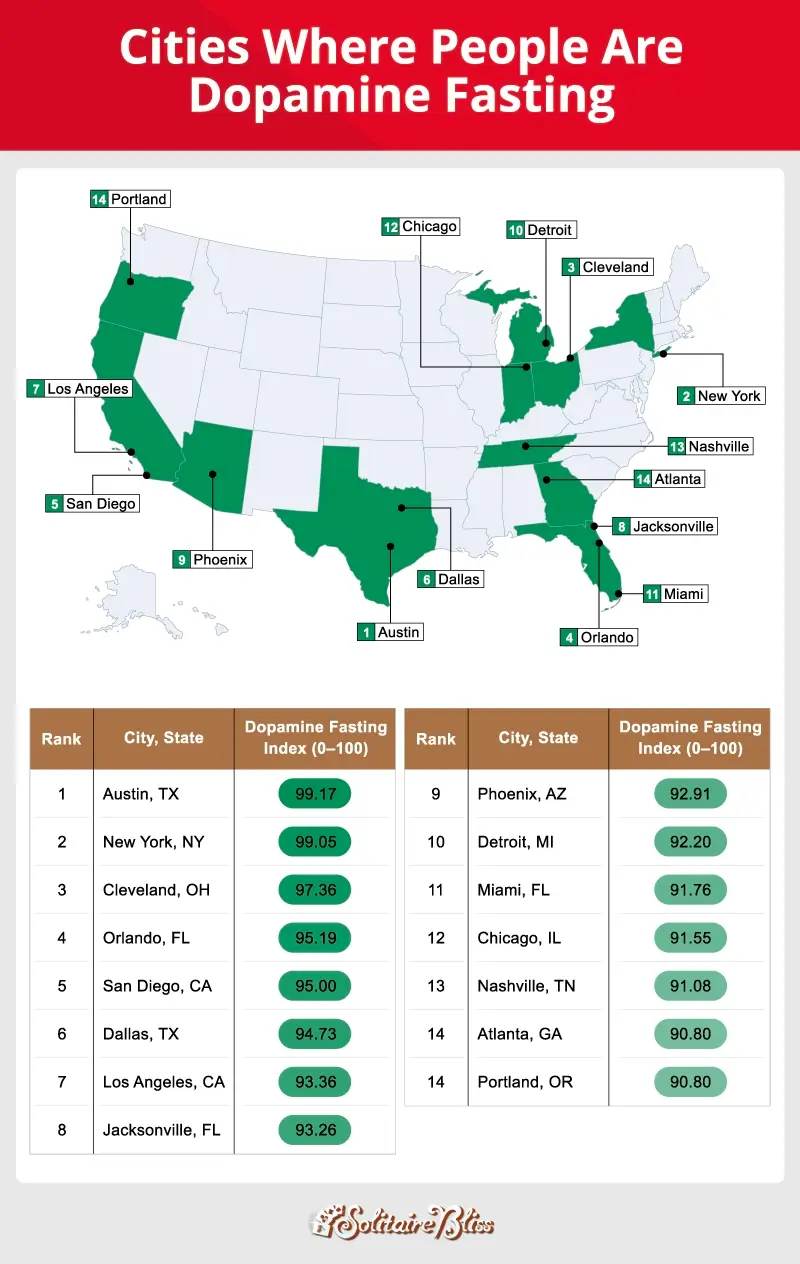
Topping the ranking with a dopamine fasting index of 99.17 out of 100 is Austin, TX. Residents of the city are the most likely to say that their breaks from certain habits typically last more than a week. Up next is the Big Apple with an index rating of 99.05 out of 100. Overall, social media, sweets, and processed or fast foods are the most common items New York, NY, residents are likely to take a break from.
Coming in third place for dopamine fasting is Cleveland, OH, where 62% of residents consider the trend a healthy practice they say they support or participate in. This is followed by Orlando, FL, (95.19), and San Diego, CA, (95.00) as the fourth and fifth most likely cities to take part in dopamine fasting.
Not all cities have flocked to this detox trend, however, as Pittsburgh, PA, Indianapolis, IN, and Boston, MA, residents rank as the least likely to take a break from stimulating activities. When looking at trends, we discovered that younger generations are more likely to take part in dopamine fasting than older Americans. Similarly, women are more likely than men to hit pause on certain habits or activities in their life for a reset.
Most Common Activities Americans Avoid
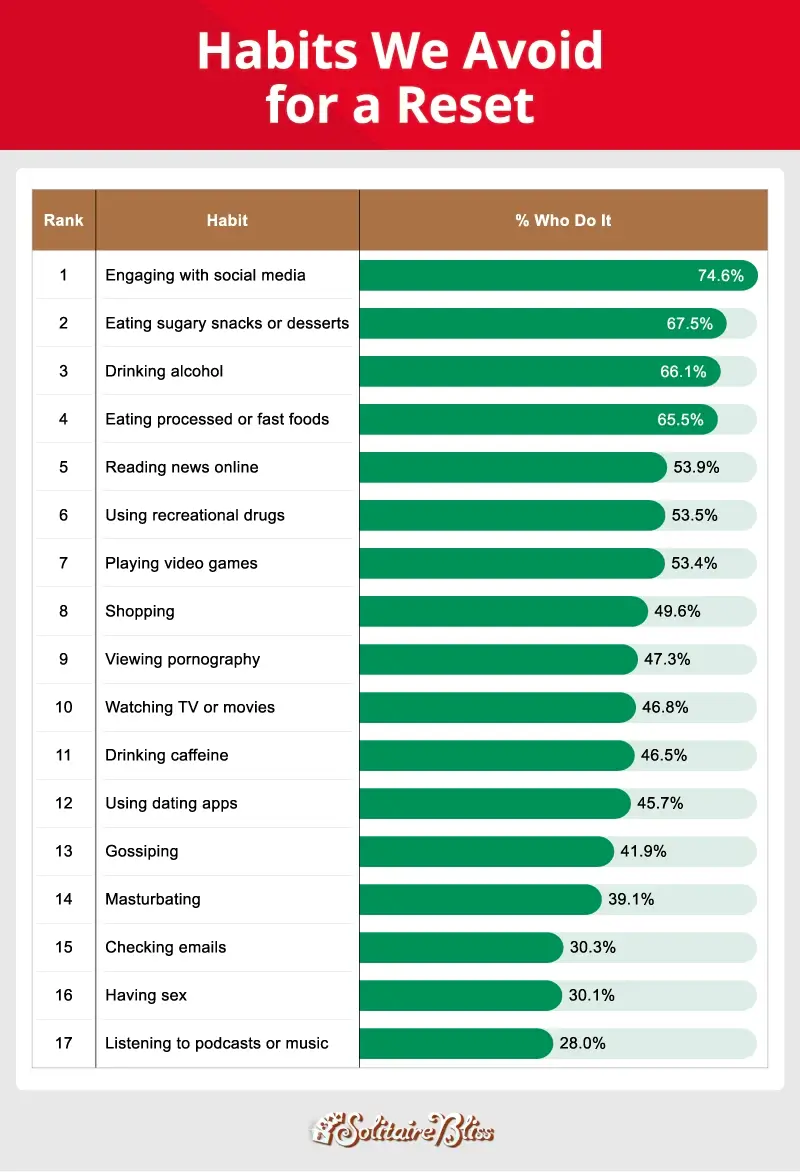
With more than half of Americans (62%) considering dopamine fasting a healthy practice they support or participate in, we wanted to gain more insight into the habits that people avoid. Up first is social media with 3 in 4 Americans reporting they have actively avoided it as part of a mental or physical reset.
While social media offers an easy way to stay connected with friends and family, experts warn there can also be many cons associated with the platforms. From distorted self-image issues to cyberbullying, social media has a variety of aspects that can make a break from scrolling timelines and for you pages a positive reset for anyone.
Up next are sugary snacks or desserts with 67% of Americans reporting they avoid them from time-to-time. Whether you are trying to lose weight or simply improve eating habits, cutting out sweets is a great way to start.
We find a similar trend regarding a potential connection to health for our next two habits people avoid. In third place is drinking alcohol (66%), followed by eating processed or fast foods (65%). Like many things in life, enjoying in moderation can be fine, but sometimes it is easy to overindulge and taking a break can help both physically and mentally.
In fifth place for activities Americans avoid is reading news online, which 54% of people note. While reading news is a great way to stay informed regarding things happening around the world, many people find themselves seeking a break from the updates.
Why Americans Take Part in Dopamine Fasting

So why dopamine fasting? For a majority of Americans (60%), detoxing from certain habits or activities helps to improve their mood and well-being. Additionally, for nearly half (48%) of the country, this break reduces anxiety or stress.
For 46% of people, dopamine fasting helps to increase focus and productivity, allowing them to put certain habits aside to focus on things they consider important in their lives. For nearly 2 in 5 people, indulging in certain habits can become addictive, and this detox helps to reduce their cravings.
Life goes by fast. One moment you are clinking glasses and saying “Happy New Year,” then the next you are gathering for Thanksgiving. This can be especially true when activities take over your free time or certain habits keep you from achieving goals you set for yourself. Perhaps this is why 39% of respondents say they dopamine fast to feel more present or mindful, soaking up every minute of their life.
Boost Your Dopamine with Solitaire
From the cities where dopamine fasting is most common to the behaviors people take breaks from, the takeaway is simple: Short breaks work best when they are kept simple. Whether you prefer to limit your break to a couple of days or you desire a longer hiatus, it’s important to continue your progress upon returning to normal life.
So if you are coming off of a fast or are simply seeking more low-key activities to engage in, Solitaire Bliss is here to help. With classic games like Solitaire, Spider Solitaire and FreeCell, you can enjoy gaming again, with steady pacing and no chaos.
Methodology
In this study, we set out to learn where in the U.S. people are taking part in dopamine fasting. To do this, we surveyed residents in 40 of the largest cities across the country and asked about their habits they take breaks from, the habits they regret overindulging in, their reasons for taking breaks, and more. Using these responses, we then awarded points to answers that represented dopamine fasting and calculated the average score by city. We then adjusted those scores on a scale of 0 to 100, with 100 representing the most dopamine fasting.
Back to the Homepage